Today, many companies have moved beyond experimentation with AI. They are testing use cases, deploying new workloads and looking for ways to scale AI across the business.
The question is becoming less about what AI can do and more about whether the underlying environment can support it. Increasingly, that means looking beyond compute to the power, cooling and facility requirements that determine how quickly AI can scale.
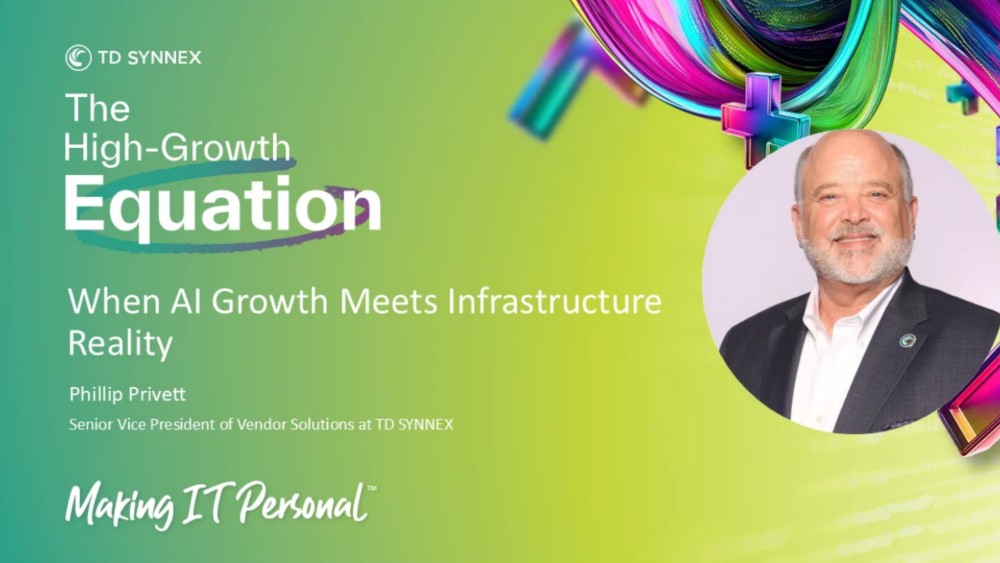
That challenge is the focus of the latest episode of The High-Growth Equation, where Lawrence Roberts sits down with Phillip Privett, Senior Vice President of Vendor Solutions at TD SYNNEX. Having spent much of his career working across solutionsdesign, architecture and services delivery, Privett brings an infrastructure focused perspective to the discussion. One theme emerges repeatedly throughout the episode: scaling AI is changing how organizations think about power, cooling and infrastructure planning.
Scaling AI Requires More Than Compute
Most organizations do not encounter the AI Energy Wall because of a single model or application. They encounter it when growth starts to compound. An AI pilot moves into production. Additional GPUs are added. New workloads come online. Cooling requirements increase. What begins as a technology roadmap quickly becomes a question of energy availability, implementation timelines and capacity planning.
This is what many in the industry now refer to as the AI Energy Wall, a challenge tied to how AI infrastructure is designed and scaled.
The term describes a growing mismatch between demand for AI capacity and the physical resources required to support it. Organizations are increasingly running into challenges such as:
- Growing power requirements from AI and high-density workloads
- Cooling systems that were not designed for modern AI infrastructure
- Facility limitations that can slow expansion plans
- Utility and grid constraints that affect deployment timelines
Taken together, these factors are beginning to influence technology decisions that were once driven primarily by performance and cost.
For years, power and cooling sat in the background of most data center discussions. Capacity planning mattered, but it rarely dictated strategy. If a business needed more compute, the assumption was that the supporting environment would be available when needed.
“Energy is really the new currency of the modern data center,” Privett explains. As AI adoption accelerates, organizations are encountering longer lead times not only for GPUs and other critical components, but also for the power and cooling systems required to support them.
Across the U.S., data center expansion and high-density AI workloads are increasing demand on power, cooling and facility resources. At the same time, many existing facilities were never designed for the power requirements associated with modern AI deployments.
Infrastructure Decisions Are Becoming Business Decisions
In some cases, the challenge is not a lack of technology. It is timing.
Organizations may have a roadmap for AI or broader modernization efforts, but those plans often assume power capacity will be available when needed. Discussions about service levels, performance expectations and implementation timelines now need to include energy availability much earlier in the process.
Historically, these decisions often remained within IT. Today, questions around power consumption, operating costs and infrastructure capacity are bringing additional stakeholders into the decision-making process, including operations and finance leaders. What begins as a technology initiative can quickly turn into a broader business strategy discussion.
Proactive Planning Creates More Options
Many solution providers have deep expertise in compute, storage and networking. Fewer have historically been asked to advise on energy availability, cooling requirements or facilities strategy. Yet those topics are becoming harder to separate from technology decisions as customers move from experimentation to larger scale deployments.
Privett points to assessments as an important first step. Understanding current energy usage, available capacity and existing infrastructure can help organizations identify opportunities, uncover potential bottlenecks and make more informed decisions about future investments.
That need for earlier planning is one of the reasons TD SYNNEX launched its Hybrid IT Energy Initiative, currently available in North America. As companies prepare for AI and other high-density workloads, energy planning is becoming just as important as performance planning.
Through assessments, specialized expertise and access to a broad ecosystem of technology providers, the initiative helps partners:
- Assess infrastructure readiness
- Understand power and cooling requirements
- Identify opportunities for modernization
- Address potential capacity constraints before they affect business objectives
- Make more informed infrastructure decisions
AI demand shows little sign of slowing down. The systems behind it are being asked to do more, often faster than they were designed for.
The companies that navigate that reality most effectively may not be the ones with the most ambitious AI strategies. They may be the ones that understand their operational limits before those limits become obstacles.
To hear more from Phillip Privett on the AI Energy Wall and the role partners can play in helping customers prepare for what’s next, watch the latest episode of The High-Growth Equation.
You can also explore additional episodes covering the technologies, market shifts and business challenges shaping the channel.
To learn more about the TD SYNNEX Hybrid IT Energy Initiative, currently available in North America, contact HybridITEnergy@tdsynnex.com.